There are many things I'm excited about right now, and since I seem to have some serious monkey-mind happening, I think I'll just make a list and forget about such niceties as, say, coherent sentences and the like.
1. I wish I knew xml, html, and sql. I'm going to have to do something about it.
2. I have to start Branching Out for the third time--arggg.
3. I am SO EXCITED about driving to Bar Harbor with Karen next weekend for her little brother's wedding.
4. One of the funniest memories I have of her little brother is him banging on the bass notes of their family's piano while Karen and I valiently tried to get through "Asa's Death" for piano 4 hands.
5. I just finished reading Buddha of Suburbia (loved it), Never Let Me Go (loved it), and In the Company of Cheerful Ladies (loved it).
6. I think that since I just finished 3 books I should get to buy more
7. I just downloaded the COOLEST SOFTWARE EVER: Delicious Library. If you're a Mac user and book lover, click here NOW: Delicious Monster
8. I'm getting Tiger next week :)
9. When I started scanning the bar-codes of the books into Delicious Library, I began to feel like the miller's daughter who had to spin straw into gold...I cannot quite explain how many books there are in this apartment. They are e-v-e-r-y-w-h-e-r-e, and double-shelved, to boot.
10. I don't know whether I should be blogging, scanning books, knitting, editing the six children's math books that are due on Wednesday, taking a bubble bath, or getting out of this chair to have a glass of port
11. I've been thinking of moving the saltwaterchronicles content over to my knitting blog...because the knitting blogs I like the best tend to have non-knitting content in them, too.
12. I would like to customize this blog template...which brings me back to item #1 on this list about learning HTML...
13. I just decided I'm going for the port.
More later.
4.30.2005


4.15.2005
Random "Red Dwarf" Thought
Just a random thought: it seems that one of the few places you can see "Red Dwarf" on PBS in the States is in South Dakota...all I can think of is the generation of children in Sioux Falls who will grow up with their sense of humor warped the way Karen's and mine were by watching British TV programs on PBS in Boston....
Catching Up
I'm not sure how I managed to miss "Red Dwarf"--or even what posessed me to add it to my Netflix list (the blurb might have compared it to Hitchhikers Guide to the Galaxy...). I've watched the first four episodes in the first series so far; the show is bizarre and hilarious--and it most definitely owes a debt to Douglas Adams with witty writing, characters like the existentially depressed toaster, and the Lister-as-god plot line (one of my favorite bits from HHGtG is the book title Well, That About Wraps it Up for God...or something to that extent). I have a two episode at a time limit, though--more than that just starts to hurt my brain (which really isn't all that difficult these days).
Life has been crazed for the past two weeks between travel (in Newburyport with Jennie and Karen then back to Boston for work for a day) and intensive QA mode at work for an upcoming db release...and intensive QA means that all my other work goes on hold...ready to spring up, all at once, the week after the release. I've also managed to get sick/get allergies which is always a fun thing to add to the mix of work/life stress. Don't even ask when the last time I went to a yoga class was.
On the positive side, the chenile baby blanket I'm working on is almost done and will require very little finishing, and I've started making up characters for a story. That's more than I usually can do creatively in the spring time, so that's good. I'd just really really really like some vacation time to re-charge and re-balance. Or maybe there is no such thing as "re-balancing"...maybe there's just figuring out how to let go/move on/deal. Who knows. Okay...more thoughts later...
Life has been crazed for the past two weeks between travel (in Newburyport with Jennie and Karen then back to Boston for work for a day) and intensive QA mode at work for an upcoming db release...and intensive QA means that all my other work goes on hold...ready to spring up, all at once, the week after the release. I've also managed to get sick/get allergies which is always a fun thing to add to the mix of work/life stress. Don't even ask when the last time I went to a yoga class was.
On the positive side, the chenile baby blanket I'm working on is almost done and will require very little finishing, and I've started making up characters for a story. That's more than I usually can do creatively in the spring time, so that's good. I'd just really really really like some vacation time to re-charge and re-balance. Or maybe there is no such thing as "re-balancing"...maybe there's just figuring out how to let go/move on/deal. Who knows. Okay...more thoughts later...
3.27.2005
"Portraits of an Age" Exhibit at Neue Galerie
Each time I go to the Neue Galerie (5th & 86th St.), I'm struck cold, forbidding grandeur of the space. Formerly a private residence, the space has been transformed into a museum that showcases German and Austrian art of the early twentieth century. There is nothing friendly or gemütlich about the Neue Galerie, from the front desk staff to the grim guards. But they have an amazing collection of Klimts and Schieles, as well as some stunning furniture, silver, and decorative arts. (And they have one of the few A+ restrooms in the city).
Their current exhitibit is a collection of photographs from 1900 to 1938. Greeting you at the top of the narrow, marble stairs is Nähe's portrait of Gustav Mahler from 1904 (taken in the Vienna State Opera); it's one of my favorite images of Mahler. There's one room of photographs from before WWI that look more like 19th-century paintings than photographs; the other rooms show portraits, self-portraits, and "snapshots" from the twenties and thirties. The sudden modernity of these images--so different from the fin-de-siecle portraits--is shocking and familiar (a lot of it looks like classic fashion photography).
The feeling that always strikes me when studying images of people from the Weimar Republic years is of overwhelming, impending doom -- a sense of dancing, painting, building, loving, as fast as you can because time is short. Some of that sense comes from a romaticisation of the period (Isherwood, Cabaret), but I always wonder when I look at these images "did this person survive the War? or this person? or this one?" There is no way, I think, for someone in the early part of the 21st-century to look at these images without seeing what came next, what shattered so many lives. The images are more than art--they are history; they have survived, and they're amazing to see, despite the acres of cold marble and wrought iron railings.
Their current exhitibit is a collection of photographs from 1900 to 1938. Greeting you at the top of the narrow, marble stairs is Nähe's portrait of Gustav Mahler from 1904 (taken in the Vienna State Opera); it's one of my favorite images of Mahler. There's one room of photographs from before WWI that look more like 19th-century paintings than photographs; the other rooms show portraits, self-portraits, and "snapshots" from the twenties and thirties. The sudden modernity of these images--so different from the fin-de-siecle portraits--is shocking and familiar (a lot of it looks like classic fashion photography).
The feeling that always strikes me when studying images of people from the Weimar Republic years is of overwhelming, impending doom -- a sense of dancing, painting, building, loving, as fast as you can because time is short. Some of that sense comes from a romaticisation of the period (Isherwood, Cabaret), but I always wonder when I look at these images "did this person survive the War? or this person? or this one?" There is no way, I think, for someone in the early part of the 21st-century to look at these images without seeing what came next, what shattered so many lives. The images are more than art--they are history; they have survived, and they're amazing to see, despite the acres of cold marble and wrought iron railings.
3.24.2005
Lookie!!
I edited my blog template and figured out how to paste the HTML generated by the blog roll wizard in Bloglines--I can really claim to be in IT now. ;)
To Yoga or Not To Yoga
Every week, I wrestle with the same demons: do I go to yoga class, or do I slink home and watch whatever is on PBS or the Netflix we have lying around the house? (Last week was a relatively stress-free choice because I was in Boston and had the opportunity to take Patricia Walden's class in Cambridge; the week before, only the changing of a light from "Walk" to "Don't Walk" changed my direction and compelled me to go to class).
It's the whole "should" phenomenon: since I feel like I should go to yoga, it somehow becomes an unattractive option. When faced with walking to the studio and going to class, hopping the train to go home to loll on the red chair suddenly seems decadent and exciting. The fact that I would not, in actuality, go home and loll on the red chair, but would instead putter around the house fretting about (but ignoring) the cat box, doing the dishes, picking up and setting down a knitting project, and pretending to read, is of no consequence at all. Going home is the incorrect choice to make...which makes it all the more compelling in my brain somehow.
Maybe the underlying issue here is that I need to (should?) remove the "should" from the equation. I could think instead "it is a privilege to go to yoga" or "it is healthy" or "I always feel great after class"--all of which are true. Thinking of the positive also focuses on the act of going to class rather than the "good/bad" dyad. But it also takes more mental energy, which I seem not to have. But is lack of mental energy an excuse for living a less healthy life? There's no downside to going to class...except moving me out of my comfort zone, which is part of the whole point.
So we'll see. Maybe I'll use the time between now and class to figure out how to get a blog roll to show up in my template...
More soon.
It's the whole "should" phenomenon: since I feel like I should go to yoga, it somehow becomes an unattractive option. When faced with walking to the studio and going to class, hopping the train to go home to loll on the red chair suddenly seems decadent and exciting. The fact that I would not, in actuality, go home and loll on the red chair, but would instead putter around the house fretting about (but ignoring) the cat box, doing the dishes, picking up and setting down a knitting project, and pretending to read, is of no consequence at all. Going home is the incorrect choice to make...which makes it all the more compelling in my brain somehow.
Maybe the underlying issue here is that I need to (should?) remove the "should" from the equation. I could think instead "it is a privilege to go to yoga" or "it is healthy" or "I always feel great after class"--all of which are true. Thinking of the positive also focuses on the act of going to class rather than the "good/bad" dyad. But it also takes more mental energy, which I seem not to have. But is lack of mental energy an excuse for living a less healthy life? There's no downside to going to class...except moving me out of my comfort zone, which is part of the whole point.
So we'll see. Maybe I'll use the time between now and class to figure out how to get a blog roll to show up in my template...
More soon.
3.23.2005
Spring Snow!
I've been trying to reassure everyone in the office that yes, indeed, it is normal for it to snow in March in New York and that the snow won't stay around for long, but I don't seem to have any takers for this philosophy. We're supposed to get 3-5 inches tonight, so it's a little bit of a tough sell. I just keep thinking that before we know it, it will be 80 degrees outside and I'll have my turn to complain about the heat (ugh).
If I had more presence of mind, these are thing things I *would* be blogging about:
1. Spending last week working in Boston last week
2. Thoughts on a cool poem about prayers being liked shoes you put on in the morning that I head on NPR the other night (ed. Found it! Ruth Forman's "Prayers Like Shoes")
3. Thoughts on just how badly I'd like to travel right now (inspired by the NY Times Travel section and, in particular, the article about a novelist who writes in various borrowed homes.
Maybe it's just enough to make a list sometimes. More soon.
If I had more presence of mind, these are thing things I *would* be blogging about:
1. Spending last week working in Boston last week
2. Thoughts on a cool poem about prayers being liked shoes you put on in the morning that I head on NPR the other night (ed. Found it! Ruth Forman's "Prayers Like Shoes")
3. Thoughts on just how badly I'd like to travel right now (inspired by the NY Times Travel section and, in particular, the article about a novelist who writes in various borrowed homes.
Maybe it's just enough to make a list sometimes. More soon.
3.11.2005
Just a Random Friday Night in Jersey City...
...so Stephen and I are both sitting at the kitchen table while Alanis Morisette and T.a.T.u. songs blast from Stephen's iTunes (insert a shudder by Michaela). There's laundry in the dryer downstairs and we're half packed for a weekend trip to Philadelphia to check out the annual Flower Show; Stephen's been reading the paper and writing in what we call his "analog blog" (paper journal) while I've been wasting time surfing and rearranging photos in Picassa. The following conversation has just occured:
Michaela: How about playing music without chicks with guitars?
Stephen: says nothing, but immediately starts playing a Silbermond tune (featuring chicks, but no guitars)
Michaela: How about just no chicks?
Stephen: How about chicks with basses? (He starts playing a song by Melissa Auf der maur (the former bassist of the Smashing Pumpkins)
Michaela: Um, no...
Stephen: Reponds by playing Bruce Springstein
I supposed I deserved that.
Michaela: How about playing music without chicks with guitars?
Stephen: says nothing, but immediately starts playing a Silbermond tune (featuring chicks, but no guitars)
Michaela: How about just no chicks?
Stephen: How about chicks with basses? (He starts playing a song by Melissa Auf der maur (the former bassist of the Smashing Pumpkins)
Michaela: Um, no...
Stephen: Reponds by playing Bruce Springstein
I supposed I deserved that.
MOBA : The Collection
For all of you art afficianados...you won't be able to stop laughing. I particularly enjoyed "Circus of Despair."
MOBA : The Collection
MOBA : The Collection
3.09.2005
Dr. Who Lives...
I admit I'm a little behind the curve on this one. But thank you to Kieran, who has just e-mailed me a link to the latest trailers for the BBC's new Dr. Who, rumored to air on March 26th. (No date set for the US, alas. But that just means there's all the more reason to get to London...).
Click here for the trailer....
Click here for the trailer....
3.08.2005
Call Me Crazy, But...
I've created a knitting blog. Essentially, this is all an elaborate procrastination technique for avoiding working on The Most Boring Project Ever (aka "Sapphire," a re-make of the poncho I made for my neice-in-law Rebecca...the original met a tragic fate...see the blog for more...).
Here it is: http://kaekiknits.blogspot.com/
More soon...many things to blog about, not enough time.
Here it is: http://kaekiknits.blogspot.com/
More soon...many things to blog about, not enough time.
2.25.2005
Program Notes...
...okay...I'm trying a trick here. I don't seem to get writers block when I write on The Salt Water Chronicles, but as soon as I open up a new Word doc and see that horrible, blank whitness staring at me, all the demons start crashing into my brain and I become convinced that there is no way I can write anything remotely intelligent about music (don't forget that part about how I never COULD write anything remotely good about music and that's why I never wrote my dissertation etc. etc. etc. It's a great tape loop I've got goin' on in this brain, trust me). SO I'm going to inflict my thoughts about Faure, Brahms, and Turina upon the unsuspecting world at large. Okay, here we go (really...honest...)
Ah-hem.
Johannes Brahms (1833-1897), Gabriel Faure (1845-1924), and Joaquin Turina (1882-1949)--composers from three different countries, whose careers shadowed historical events from the creation of the German state to the horrors of WWII and the Franco Regime--created vastly disparate and unique sound worlds.
Although the formal structure of the first movment of Faure's Op. 15 hews to a clear, fairly strict sonata form, he creates intensity from through his rich and complex harmonic language . He frequently employs intense, slithering chromaticsm to create color in his unique sound world. Despite the minor key of the movement, the music contains little Sturm und Drang. Instead, it is filled with moments of space and tranquility created by his specific dynamic markings and textures.
The opening movement of Brahms' Op. 25, on the other hand, fully inhabits the word of storm and stress. Phrases ache with yearning and forward motion; moments of jubilance are subsumed by mystery and darkness. The first movement of Op. 15 also clearly illustrates Brahms' use of continuous development, a hallmark of his style. Brahms almost never presents material the same way twice, but instead will alter the key, or the texture, or the harmonic underpinnning. In this way, he commands our attention and creates a distinct style.
Better known for his guitar and keyboard works, Turina wrote just one Piano Quaret. He creates a third, unique sound world that is strongly influenced by the rhythms and harmonies of Spanish folk music. Like Brahms, he restates themes throughout a piece, but without the intense contrapuntal textures. Instead, Turina creates drama through dotted rhythms, pizzicato,and exploting the extremes of each instrument's register.
Each composers' work reveals different aspects of the Piano Quartet medium. Their approaches to harmony, form, and texture create sound worlds that allow us to escape for a moment from our own.
ARGGG--okay, enough of this torture. Why I turn all formal and my thoughts freeze when I start writing about music...I don't know. I'll look at this again tomorrow. Blah.
Ah-hem.
Johannes Brahms (1833-1897), Gabriel Faure (1845-1924), and Joaquin Turina (1882-1949)--composers from three different countries, whose careers shadowed historical events from the creation of the German state to the horrors of WWII and the Franco Regime--created vastly disparate and unique sound worlds.
Although the formal structure of the first movment of Faure's Op. 15 hews to a clear, fairly strict sonata form, he creates intensity from through his rich and complex harmonic language . He frequently employs intense, slithering chromaticsm to create color in his unique sound world. Despite the minor key of the movement, the music contains little Sturm und Drang. Instead, it is filled with moments of space and tranquility created by his specific dynamic markings and textures.
The opening movement of Brahms' Op. 25, on the other hand, fully inhabits the word of storm and stress. Phrases ache with yearning and forward motion; moments of jubilance are subsumed by mystery and darkness. The first movement of Op. 15 also clearly illustrates Brahms' use of continuous development, a hallmark of his style. Brahms almost never presents material the same way twice, but instead will alter the key, or the texture, or the harmonic underpinnning. In this way, he commands our attention and creates a distinct style.
Better known for his guitar and keyboard works, Turina wrote just one Piano Quaret. He creates a third, unique sound world that is strongly influenced by the rhythms and harmonies of Spanish folk music. Like Brahms, he restates themes throughout a piece, but without the intense contrapuntal textures. Instead, Turina creates drama through dotted rhythms, pizzicato,and exploting the extremes of each instrument's register.
Each composers' work reveals different aspects of the Piano Quartet medium. Their approaches to harmony, form, and texture create sound worlds that allow us to escape for a moment from our own.
ARGGG--okay, enough of this torture. Why I turn all formal and my thoughts freeze when I start writing about music...I don't know. I'll look at this again tomorrow. Blah.

2.21.2005
I HATE Practicing...
I would just like to state, for the record, how much I hate hate hate hate hate practicing. I have never liked practicing, even for the brief years when I actually made an effort and practiced four hours a day (it was a long time ago, and yes, I'm glad that I did it). There are moments when I love playing, and it sends me into raptures. But those are few and far between. I suppose that's the difference between "practicing" and "playing" anyway.
The fingertips of my left hand have turned black and sting. And I still can't play the damn cross-string work in the recap of the Brahms, which, because I love so much, I want to play perfectly. And as for the Turina, all I can say is starting a phrase out of thin air on the B two octaves above middle C is just not funny. WhatEVER...
The fingertips of my left hand have turned black and sting. And I still can't play the damn cross-string work in the recap of the Brahms, which, because I love so much, I want to play perfectly. And as for the Turina, all I can say is starting a phrase out of thin air on the B two octaves above middle C is just not funny. WhatEVER...
2.20.2005
Thoughts About Christo & Jeanne-Claude's "Gates"
(Can you tell I'm catching up on my blogging?? I have at least three thoughts a day that cause me to say "I have to blog about that" but then I am either in the middle of troubleshooting an issue at work, or not near anything to write with and have to remember to post later...so here they all are)
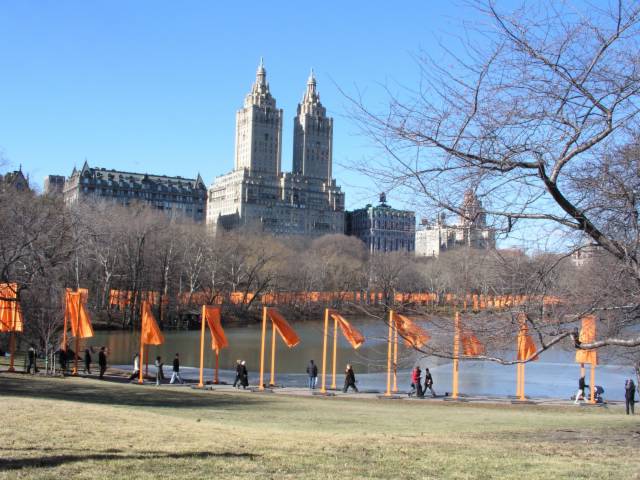
Stephen, Kate, and I spent Saturday afternoon at Central Park experiencing the Gates. The overall vibe in the park was one of wonder and happiness--despite the 30ish degree temperature, it was mobbed (although you won't be able to see that in the photos due to Stephen's aversion to taking photos that include people). I overheard a woman say to her two friends (in a classic outer-borough accent, mind you): "This just doesn't do anything for me." There have been quite a few spoofs of the project, too--check out Boing Boing for a good sampling (the source of all that is wacky on the web...scroll down the posts for 2/20).
Before jumping into the debate "what is art?" that surrounds the project, I'll tell you that I loved the Gates--the experience of walking around them, running under them, jumping up to touch the fabric, standing on their bases, watching other people look and think about them. The structures themselves are not profound, or even necessarily "pretty" in and of themselves--the fabric looks like polyester draperies from the 1970's and the supporting structure is covered in plastic (some gates had started to crack). What's remarkable is how simple, replicated structures can transform both how you move through space and what you think about that space. I've walked down paths in Central Park many times, but never with the same intensity, never thinking "let's go that way because of the curve of trail!" You notice paths (and conversely, what's off the path) differently when the space is demarcated so vividly.
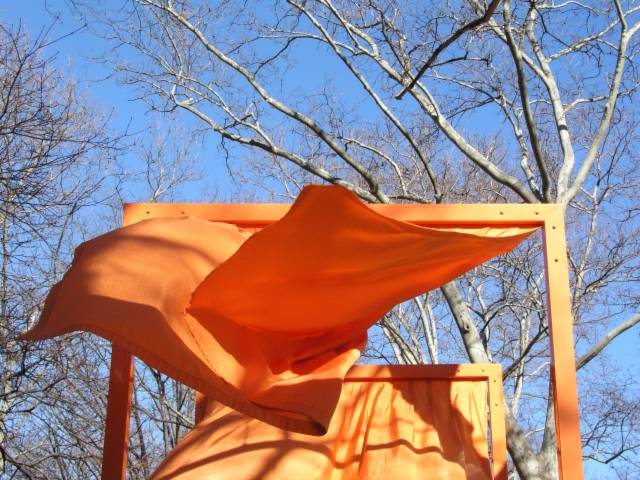
We were lucky, too, to have bright sun and blue sky, which provided a sharp contrast for the saffron cloth. In some light, the cloth looked bright orange, sometimes more yellow, softened by the sun seeping through, and sometimes it seemed to fade to a pale tan. The wind played tricks with it, causing the cloth on one gate to billow while others stayed still.
I've overheard buzz, though, that somehow the Gates are not "Art" with a capital "A". I say "why not?" (along with "who-cares-about-defining-what-art-is-this-argument-makes-me-so-tired" but I brought it up...) The Gates changes the way you see--the way a painting or sculpture or graffiti can challenge you to change the way you see. It alters the way you view a familiar space (even if you haven't been to Central Park, you've seen it in movies and photos) by defamiliarizing and recasting it. It may not inspire awe, the way some works of art do (Serra's sculptures come to mind), but it brings art into the world and encourages people to look and think--which is the whole point, as far as I'm concerned. :)
Stephen, Kate, and I spent Saturday afternoon at Central Park experiencing the Gates. The overall vibe in the park was one of wonder and happiness--despite the 30ish degree temperature, it was mobbed (although you won't be able to see that in the photos due to Stephen's aversion to taking photos that include
Before jumping into the debate "what is art?" that surrounds the project, I'll tell you that I loved the Gates--the experience of walking around them, running under them, jumping up to touch the fabric, standing on their bases, watching other people look and think about them. The structures themselves are not profound, or even necessarily "pretty" in and of themselves--the fabric looks like polyester draperies from the 1970's and the supporting structure is covered in plastic (some gates had started to crack). What's remarkable is how simple, replicated structures can transform both how you move through space and what you think about that space. I've walked down paths in Central Park many times, but never with the same intensity, never thinking "let's go that way because of the curve of trail!" You notice paths (and conversely, what's off the path) differently when the space is demarcated so vividly.
We were lucky, too, to have bright sun and blue sky, which provided a sharp contrast for the saffron cloth. In some light, the cloth looked bright orange, sometimes more yellow, softened by the sun seeping through, and sometimes it seemed to fade to a pale tan. The wind played tricks with it, causing the cloth on one gate to billow while others stayed still.
I've overheard buzz, though, that somehow the Gates are not "Art" with a capital "A". I say "why not?" (along with "who-cares-about-defining-what-art-is-this-argument-makes-me-so-tired" but I brought it up...) The Gates changes the way you see--the way a painting or sculpture or graffiti can challenge you to change the way you see. It alters the way you view a familiar space (even if you haven't been to Central Park, you've seen it in movies and photos) by defamiliarizing and recasting it. It may not inspire awe, the way some works of art do (Serra's sculptures come to mind), but it brings art into the world and encourages people to look and think--which is the whole point, as far as I'm concerned. :)

Books in Waiting
As I've mentioned before, my "Books in Waiting" pile (along with my knitting "works in progress," which I'll save for a different post..) is now officially out of control. Here's a sampling of what's in it, after a visit to the first New York outpost of McNally Robinson Booksellers:
Babyji, Abha Dawesar
The Chinese Bell Murders, Robert Van Gulick
This Earth of Mankind, Pramoedya Ananta Toer
Women of Sand and Myrrh, Hanan al-Shayakh (she also wrote Only in London, which I loved)
The Rice Mother, Rani Manicka
McNally Robinson has done something I consider quite daring in it's organization of fiction: it sorts fiction first by region. That means you can browse South Asian fiction, or Japanese fiction, or the literature of Oceania. (They also have a "literary nomad" section for authors like Salman Rushdie and Vladimir Nabakov). Part of the reason that I read is to delve into worlds unfamiliar to me, and to travel mentally to regions of the world that I haven't seen yet (yes, I hold out hope that I will see all of this world somehow). I think their organization allows people to stumble across authors that they may not know, and might not have found otherwise. The danger is that it might "pigeon-hole" authors in ways antithetical (or irrelevant) to the subjects they write about. I think, though, that they've made an effort to make sure that the books are about the place in which they've been sorted.
More on the books later--the most difficult choice is going to be where to start...
Babyji, Abha Dawesar
The Chinese Bell Murders, Robert Van Gulick
This Earth of Mankind, Pramoedya Ananta Toer
Women of Sand and Myrrh, Hanan al-Shayakh (she also wrote Only in London, which I loved)
The Rice Mother, Rani Manicka
McNally Robinson has done something I consider quite daring in it's organization of fiction: it sorts fiction first by region. That means you can browse South Asian fiction, or Japanese fiction, or the literature of Oceania. (They also have a "literary nomad" section for authors like Salman Rushdie and Vladimir Nabakov). Part of the reason that I read is to delve into worlds unfamiliar to me, and to travel mentally to regions of the world that I haven't seen yet (yes, I hold out hope that I will see all of this world somehow). I think their organization allows people to stumble across authors that they may not know, and might not have found otherwise. The danger is that it might "pigeon-hole" authors in ways antithetical (or irrelevant) to the subjects they write about. I think, though, that they've made an effort to make sure that the books are about the place in which they've been sorted.
More on the books later--the most difficult choice is going to be where to start...
Latest Music Obsession--Joanna Newsom
...So Stephen and I were sitting in the cafe in Casco Bay Books last weekend, sipping lattes and trying to restrain ourselves from running through the stacks pulling books off the shelves like over-zealous two-year olds (with charge cards, alas) when all of a sudden a new track started playing and I said "What on earth is THAT?" I wavered between thinking Joanna Newsom's voice was the most god-awful affectation (think of an odd cross between Janis Joplin, PJ Harvey, Edie Brickell, and Bob Dylan) and the most brilliant, new, exciting sound I'd ever heard. I decided on the latter. You'll love it, or you'll hate it--there's no middle ground--but it's worth a listen (there are some clips in the link above). It's the only CD I've wanted to listen to over and over and over again in something like ten years.
Subscribe to:
Posts (Atom)